


|
|
|
|
Boxe Fancaise Savate - Combative art of France |
|
| Brief History: | ||
| Savate's origins are traced to the late 1700's. It is recorded that French sailors from Marseilles France adopted kicking techniques from Asia cultures while voyaging and trading throughout the Indian oceans and the south China seas. As these kicking techniques of this kind grew in popularity with French sailors it was frequently practice aboard their ships. Sailors would place their hands on the deck when executing these kicks, it has been suggested that this was for balance when the ship was moving in wavy sea's. It has also been suggested that this may have been a kicking style that they adopted from Asia. Bouts against one another of this kind became common the sailors as they voyaged back home. This form of activity also had had become a sport between sailors to overcome boredom on the high seas. | ||
 |
||
Above: Perhaps
one of the most important single documents of Chausson is a sketch from
1847 of sailors displaying kicks against one another. Ship was rope used
as boundary markers when bouts took place and technique of touching the
deck with the hand for balance was common. |
||
As this kicking contests gained popularity among the French sailors, it would become known as Chausson Assaut (Contest skill with slipper) or Chausson Coup de pied (Kicking with a slipper) Chausson at that time period was a type shoe made from soft leather with no hard sole on the bottom that sailors wore. Chausson slippers gave French sailors stable traction while walking on slippery wooden decks and climbing up & down sail ropes on these early century sailing ships. As French sailors dock into famous homeports such as Marseilles they would change out of their known slippers and weir buckle street shoes that consist of hard leather soles for comfortably while walking on cobblestone streets. At times, sailors would find themselves involved in brawls at waterfront bars and street confutations. Chausson kicking techniques provided them with an adequate defenses and proved worthy in needed times. As the public became more aware of this combat form, it would later be known as Savate de Marseilles, Savate (shoe) and Marseilles, port in the South of France. |
||
| When Savate's popularity had spread over France it gained notoriety through other practitioners as well. This shared experience came when Spanish sailors shared the same sea's as France. It was not uncommon to have French and Spanish sailors aboard one another ships under slavery, war, and stowaway circumstances in the 1600 to 1800 century. Other items merged from this mixer of activity were weapons. Weapons such as the La Baton, a seven foot staff rod approximately one inch diameter were commonly practice by Savate practitioners. It was particular famous among hillside and farming communities of France and Spain. There is no particularly evidence on where the La Baton came from but it has been suggested that this weapon came into existence by farmers and sheep herders tools such as walking staffs and garden tools. The more famous and popular weapon incorporated by Savate is the La Canne. A 1/2 inch diameter flexible stick approximately 36 inches in length. Savate combines traditional fencing motions along with kicking techniques when wielding this dowel shape stick at the opponent. This weapon is fast and flexible making it a fierce companion. La Canne is a mimic relic of the fencing foil which has been famously lead by French masters for centuries. The La Canne was frequently used in the late 1800's as a walking stick and fashion statement by gentleman of the times. The public may have seen men walking with a cane and properly dressed as a important figure of the public, but hoodlums and robbers saw them as victims. The defense techniques of La Canne & Savate proved worthy against unwelcome criminals that had planned to take ones purse or life in unsafe streets. Unlike the western world firearms were not available to the public as a mean of defense. As with many empty hand techniques that are founded, it provides a well resource for self protection purposes. | ||
 |
Left:Charlemont in 1920 performing Savate
with street cloths and top hat. Savate had originally come from the streets
of France and was used as a self-defense form at any giving time. |
|
| When Savate reputation reached Paris a practitioner named Michel Casseux develop Savate techniques to a semi learning system. He publicly taught and displayed Savate in 1820 within a Salle (training hall). Savate at this time not only had flamboyant kicks but open hand strikes. The open hand strikes perhaps came from providing protection from ones own hand when striking a bone area of the head. It is also been noted that the lack of knowledge on closed fist techniques is also why they used open hand blows. It is however documented that a pupil of Michel Casseux named Charles Lecour introduced English Boxing to Savate techniques in 1830. Savate practitioner Charles Lecour had lost a bout against an English Boxer named Owin swift, this lost drove Lecour to learn and master English Boxing. Lecour had moved to London to purposely study English Boxing by establish champions of the time. When lecour returned to Paris, France in 1830 he opened a formal gym and renamed Savate to "La Boxe Francaise Savate" (Kickboxing of France). | ||
| Lecour had attracted many practitioners including a famous known individual named Louis Vigneron a overpowering man of streingh. Vigneron gained his reputation not only in the ring with Savate but outside the as well by shooting a 500-lbs. cannon while it wrested upon his shoulders. The Cannon ball was attempted to be caught by his pupil Alexandrini when fired. Both men were eventually killed by this unusual feat. | ||
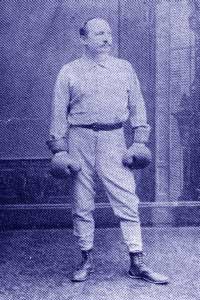
| Other figures of Savate that merged out of this time period was Joeseph Charlemont. Charlemont perhaps one of the most important figure of Savate boxed while he was performing military duty. Charlemont went on to fight well known boxers at that time period including Vigneron. Charlemont taught Savate and La Canne up until the French and Prussia war in 1870. Charlemont escaped being captured from monarchist in Paris by using Savate fighting techniques. He had fled to Belgium for several years there he taught and published the first book on Savate techniques. These same methods and regulations are the guidlines used in todays Boxe Franciase Savate. When Joseph Charlemont returned to Paris in 1877 after the occupation parties disappearance he was welcomed with great honors. | ||
 |
 |
|
| Above: Joseph Charlemont was one of the first to establish Savate into a formal system and had publish the first book on Boxe Franciase Savate. | ||
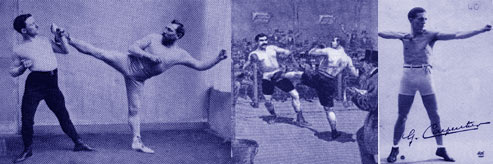
| Joseph Charlemont had a son in 1877 named Charles Charlemont who would carry on the the tradition and have just as much impact on the development of Savate popularity. Charles Charlemont a practitioner of Savate at the age of ten would go to master Savate techniques by his early twenties. He brought recognition to Savate when he beat English boxing champion Jerry Driscoll in 1899. A debate with public had been discussed and brewing for some time on the subject of whom would be a greater successor in a match between an English Boxer and a Savate Professior. News papers and head figures witness the outcome as Charlemont punished Driscolls body with a series of powerful kicks, that disabled Driscoll to continue the bout. Charles Charlemont years following would successfully teach Savate and have famous students such as Georges Carpentier a champion of France in 1907. Carpentier turned world title holder in English Boxing would later fight against champions like Jack Dempsey in1921. | ||
Below left:
Charles Charlemont son of Joseph executing a Foutte Figure (kick to the
head) at an opponent. Middle: The great fight between Charlemont and
Driscoll, news papers cover the event as charlemont won with kicking
stratigies. Far right: The late George Carpentier a world champion boxer
also known as a Savate practitioner under Charlemont.
|
||
 |
||
| With the invasion and occupation of the Second World War in 1940 it had left France in shambles. Mass destruction of communities nearly vanished all practitioners of Savate. After the victory by the USA, English Boxing had become the favorite past time and ring sport of the decade and slowed Savates popularity. Today Savate has reached the four corners of the globe with competitors & practitioners. It truly has become the martial art of France. | ||