

|
|
|
|
All In Wrestling - Submission Wrestling |
| Brief History: | |
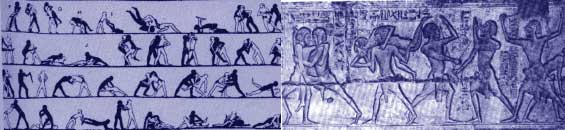
| The art of wrestling as a sport and method of defense goes further back in time than any other excising records of empty hand combat. It can be traced back as far as 3400 BC when the Egyptians practiced wrestling as a favorite past time event event. These recorded images of wrestling artifacts can still be seen today in the tomb walls of Beni-Hasan Egypt and relief images from the tomb of Vizier Ptahhotpe in Saqqara. More reveling is the exact methods used in today's wrestling are in scripted upon these same walls. These paintings and images date back as far as 2300 BC. | |
| Wrestling was not initially a spectator sport as first portrayed at Olympia. It was founded more upon conditional activity that mocked combative techniques to strengthen ones survival skills. Conflicts of war between civilization, tribes and empires were not uncommon, particularly in a time of hostility. Signs of paramilitary sports played great importance for rulers and solders of the ancient world. The same wrestling founded upon the walls of Egypt are displayed side by side with military activities suggesting wrestling was an important part of the solders training from the beginning. | |
 |
|
| Wrestling like any other survival tool for humans, would eventually become a symbolic message. These messages can clearly be seen on ancient artifacts such as metal coins and pottery vases from Greece. These pictured artifacts show wrestling not only as a form of human strength but as a form of human courage. This text perhaps suggest that ones strength against the odds in life is as important to a strength of a nation. | |
| Other important past icons would also tell us of wrestling as well. Plato who was a member of the Palaestra (Greek Gyms) as youth, speaks of wrestling through his philosophies. Although ironically Plato himself desired hand weapons more than any other combat form. | |
| But if wrestling was a symbolic message of strength could it be translated to a higher level than just a philosophy or a way of defense? Perhaps so, demonstrations of this type of text has been part of biblical stories for centuries. Prophets & Angles that wrestled with beast displayed fearless strength which elevated mans spiritual being. The 32nd chapter of Genesis describes "Jacob" was left alone to wrestle beats or man until the breaking of the day. | |
| With the varieties of wrestling that exist through different cultures and civilizations each have different standards, regulations and training methods that provide guidelines for its method wrestling. These are determined by the social customs on which the wrestling system originated from. We know six centuries before Christ the Greeks established not only their architectural civilization but also wrestling. First introduced to the Olympia Games in 704 BC wrestling at this time was dominated by the Spartans a breed well known for there military tactics. Wrestling in the 9th BC had reached the Roman Empire by the Etruscans and had slowly evolved into a more entertaining and exciting sport. Pure Greek wrestling in the 3rd BC was recorded as static and unexciting for Olympia spectators, this was from the continues hours of wrestling upon the ground with little movement from the contestants. This change when the Roman Empire concord Greece in 2 BC. Roman paramilitary tactics such as upright takedowns while equipped with armor provided the Romans an effective defense against their adversary's among the battlefields. Merging of the Greek and Roman wrestling methods sculpted the name Greco- Roman style which provided efficient standing throws with exceptional ground skills. Other exciting events that had become part of Olympia history were the feared Pankrantion participants of the games. First introduced in the 33rd Olympia 648 BC the art of Pankrantion combined skills of formal boxing, kicking tactics and wrestling techniques to the arena. Participants of Pankrantion bound their fist with hemp rope and imbedded spike like objects within the hemp itself above the knuckles. This added protection while providing a lethal weapon to the contestants fist. The word "Cactus" today derived from the Greek word Caetus meaning (spike). Some events of this kind at Olympia were known as "Cactus fighting" or fighting with spiked hands. | |
| These weapons of destruction which formed to the hands of the fighter caused incredible damage to many of the contestants. Death was not uncommon at this past time Olympia event. As contestants of Olympia pushed the limits of such a sport so did the spectators, and finally man would no longer just wrestle man but more animalistic opponents, the lions of Africa. This form of an opponent for man was truly greater and man would rarely concord such a beast. But for Olympia spectators there was a fine line between winning and losing, victory was often found in ones courage rather than in the triumphant over an opponent. At Olympia it was often better to die with great courage than to surrender to ones limits. | |
| Other ancient forms of European wrestling can be found in the British Isles dating back as far as 1829 BC. Wrestling forms known as Lancashire, Cumberland, Cornwall and westmorland were commonly known as "Strong Arm Fighting" Events of this wrestling were named generally named after their founded region and were commonly practice in church yards. Jacket with heavy collars and waistbands were worn to grab hold of one another. Men of Cornwell and Devonshire England were exceptional known for their throws and techniques. Famous leaders such as Henry VIII of England and Abraham Lincoln of the USA were great practitioners of Cornish and Catch as Catch Can wrestling from Lancashire. | |
| Other varieties of wrestling found in Europe include Glima from Iceland and Switzerland Schwingen wrestling. Both of these methods are linked to the Viking Era and have a history of four thousand years. Wrestling among the Scottish was famous not only on the battlefield against there opponents but also against there opponents in the famous Highland games which still exists today. | |
| One of the most religion and ancient forms of wrestling that exist is Indian wrestling from India. Traditional Indian wrestling has been around since 11 AD and is integrated with the religion of Hinduism. Indian wrestling known as Pahalwani or Mallavidya is a form exercise that defines the essence of wrestling and man. Through the eyes of Indian wrestling one achieves not only self discipline through physical fitness but achieves identity and purity of the body, mind and spirit. Training resides at the Akharas (temples, gyms). When one enters the temple he leaves behind him the civilization that he is part of and enters a world of tranquility and acknowledgment. Akharas are equipped with fine grit dirt floors to bring one closer to natural elements of the earth. Dirt floors that cover the training have been shifted and saturated with essential oils to supple the skin of the wrestler when he is wrestling. The oils also keep the dirt clean and compressed for body's to tumble upon. Natural light and fresh air impact the training area as well to keep it in harmony with the surrounding atmosphere. Strength training is performed religiously. Indian wrestler are well known for there flexibility and power. This is achieve through several types of exercises done with ones own body weight. Performing exercises such as Yogi (posture stretches), Bethak (in place squats), Dand (push ups), Jori (swinging weighted wooden clubs) Gada (swinging weighted ball and mace) and body massages gives the wrestler a complete regiment. | |
| A well known champion from India in the 1930's known as "The Great Gama" performed several thousand of Bethak (squats) daily for routine training. "Gama" like many Indian champions are noted for there size, strength and knowledge. Other forms of wrestling that have appeared out of India is Vajra-Musti wrestling. Contestants face each other with claw daggers in one hand while using wrestling techniques. This form of wrestling was banned because of frequent fatal wounds to the opponent. It can still be seen today at fairs and gatherings for demonstration purposes. | |
| Africa and its naboring countries of the north such as Turkey and Iran have also played a major roll in wrestling. Turkish style wrestling called Kuresh and Iran style wrestling Paklewani have been into existing for more than 1000 years. Introduced to them by the Africa's culture, Middle Eastern countries and parts of Europe the Turkish wrestle has unique features to its style. Traditional Kuresh wrestlers drench their bodies in olive oil while wearing knee high leather pants. The oil makes their skin supple and making it difficult to hold on to the opponents body while wrestling. This puts great demand not only on the wrestlers techniques but on maintaining a secure hold and control over the opponents slippery limbs. The leather pants give protection to the wrestlers legs for Kuresh wrestling is known to wrestle for several hours at a time while upon grassy fields. | |
| Famously known for their martial art forms Asia's history of wrestling such as Japanese Sumo wrestling dates back early as 23 BC in the 7th year of Suinin Emperor. China's wrestling styles like Choa Shua, Sanda, Chin-Na are a direct link to Tibetan and Mogul empires. More famous grappling forms like Jujitsu and Judo were born in Japan around 1600 AD. Formally trained by the Samurai class it was first known as Kumiuchi (grasping the Samurai empty hand). Judo founded in 1850 a later relative of Jujitsu is similar in every fashion and has been part of the Olympic games since the early 1900's Both Jujitsu and Judo weir heavy jackets called "Gi's". This type of training teaches one to secure a firm grip in numerous positions to permit submission locks on the opponent. Over several hundred forms of Jujitsu exists today with just a few Judo forms existing. | |
| With many varies forms of wrestling that exist throughout the world they all have one basic element in common, the skill of close quarter combat. The engagement of two individuals locking limbs and body's may seem primitive but wrestling displays a high degree of skill in the science and the knowledge of leverage and fulcrum. A wrestler must learn to attack and counter attack in varies position that are constantly changing direction. This performance of strength and athleticism is dynamic in coupling ones agility and patience. | |
| In the early part of this century, particularly in the U.S. the sport of wrestling bored some public audiences because of its strategy of patience. Submission wrestlers may have found themselves in 30 minute to 3 hour bouts with little signs of movement. From the spectator viewpoint this had become a unexciting form of entertainment and at this point in time English boxing was becoming the next favorite past time competitive sporting event. | |
| One of the greatest wrestlers of this century
is the legendary "Great Karl Gotch". Karl Gotch is famed for his wrestling experiences and extraordinary submission locks. Born in Germany in 1924, Karl Gotch started wrestling at the age of 9 years of age. Through rigorous training and winning countless matches Karl Gotch would be known by his opponents as a Shooter ,a slang word known in the early part of the century as a wrestler who wins by submission locks. Known to the Japanese wrestling community as the "Wrestling God", Karl Gotch is known to possess over 1000 different submission locks in his repertoire. With over 65 years of wrestling history behind him, his magnificent skill and knowledge turns the sport of wrestling into a highly technical science. |
|